Basic Information
| Detail | Information |
|---|---|
| Full name | Praskovia Fyodorovna Dubrovina |
| Also known as | Praskovya, Praskov’ya, Praskovia Rasputina |
| Born | c. 1865 or 1866 |
| Birthplace | Siberia, likely the Tobolsk region |
| Father | Fyodor Dubrovin |
| Husband | Grigori Yefimovich Rasputin |
| Marriage | February 1887, according to commonly cited accounts |
| Children | Seven births are reported, with three surviving to adulthood |
| Known surviving children | Dmitri, Maria, and Varvara Rasputin |
| Residence | Pokrovskoye, Siberia |
| Died | c. 1930 or June 1936, according to differing accounts |
| Historical identity | Wife of Grigori Rasputin and mother of his surviving children |
Praskovia Dubrovina lived a life that unfolded mostly in the shadow of one of the most controversial men in Russian history. While her husband, Grigori Rasputin, became a celebrated mystic, feared political influence, and notorious figure at the imperial court, Praskovia remained largely connected to the Siberian village of Pokrovskoye. Her world was domestic rather than political, yet the storms surrounding her husband eventually reached her doorstep.
I find Praskovia especially interesting because her story offers a different view of the Rasputin family. Rasputin is remembered through palace intrigue, rumors, assassination, and the collapse of the Romanov dynasty. Praskovia’s life was much quieter. She was a peasant wife and mother who spent years raising children while her husband traveled as a religious wanderer and later moved between Siberia and St. Petersburg.
Her story also became tragic after the Russian Revolution. The family that had once benefited from Rasputin’s proximity to the imperial household eventually became vulnerable under the Soviet system.
Praskovia Dubrovina’s Early Life in Siberia
Praskovia was born around 1865 or 1866 in Siberia. The precise place of her birth remains uncertain, although the Tobolsk region is frequently associated with her family. Her father was Fyodor Dubrovin, also recorded as Fiodor or Fedor Dubrovin.
Her background was firmly rooted in the Siberian peasantry. Unlike the aristocratic women surrounding the Romanov court, Praskovia had no formal position, inherited title, political influence, or documented independent profession. Her early education and personality are poorly recorded.
This lack of documentation is important. Much of what we know about Praskovia comes indirectly through accounts of Rasputin, their children, genealogical records, photographs, and later descriptions. Her own voice is almost completely absent.
She entered adulthood in a rural society where marriage and family were central to a woman’s life. In 1886, she reportedly met Grigori Rasputin in Abalak, near Tyumen. Their courtship lasted only several months before they married in February 1887, although some accounts give slightly different dates.
The marriage would eventually connect a Siberian peasant household to the highest levels of imperial Russia.
Marriage to Grigori Rasputin
Grigory Yefimovich Rasputin, born January 21, 1869, hailed from the same vast Siberian peasant background as Praskovia. He became a traveling mystic and religious figure who gained the attention of Tsar Nicholas II.
Praskovia stayed with him after long absences. Before his unique affiliation with the imperial family, Rasputin traveled extensively as a pilgrim and religious seeker.
In the early 1900s, his life was increasingly split. He met influential people in St. Petersburg while his wife and children lived in Pokrovskoye.
Praskovia’s marriage needed much of patience. Rasputin was known for affairs, drunkenness, eccentric religion, and scandal. Many tales portray Praskovia as his loyalist.
Their friendship connects two worlds. On one side was a peaceful Siberian home. On the other was the glittering, unsteady imperial court.
Praskovia and Her Children
Praskovia and Rasputin are generally said to have had seven children, although the precise names and dates vary between accounts. Several died during infancy or childhood.
Among the children associated with the family are Mikhail, Anna Grigorievna, Georgi Grigorievich, an unnamed child, Dmitri, Maria, and Varvara.
The three children who survived into adulthood were Dmitri, Maria, and Varvara.
Dmitri Grigorievich Rasputin
Dmitri, sometimes spelled Dmitry or Dimitri, was born around 1895 or 1897. He remained closely connected to his mother in Siberia.
His later life was dramatically different from his father’s years of imperial access. After the Revolution, the family lost property and social privileges. Around 1920, property associated with Dmitri was confiscated.
In 1922, Praskovia, Dmitri, and Varvara were reportedly deprived of voting rights after being classified among socially undesirable or “malicious” elements.
Dmitri was eventually arrested during the Soviet repression of the 1930s. Accounts place his death somewhere around 1933 to 1937, with some traditions connecting it to a labor camp in the Salekhard region and describing scurvy as a cause of death.
His wife Feoktista and their daughter Elizaveta were also caught in the wider tragedy surrounding the family.
Maria Rasputin
Maria, baptized Matryona Grigorievna Rasputin, was born on March 26 or 27, 1898. She became the most famous of Praskovia’s children.
Unlike her mother, Maria eventually left Russia and built a public identity of her own. She spent time with her father in St. Petersburg and later emigrated following the Revolution.
In exile, Maria worked as a dancer and circus performer. Her unusual career eventually included work involving tigers, an astonishing contrast with her mother’s quiet Siberian life.
Maria also became an important interpreter of her father’s legacy. Through memoirs and public appearances, she defended Rasputin and presented a more sympathetic portrait of him than many contemporary critics had offered.
She married Boris Soloviev and later Gregory Bernadsky. Her descendants continued the family line outside Russia.
Varvara Rasputina
Varvara, also known as Barbara, was born around 1900. She remained in Siberia with her mother and brother.
Her later fate is uncertain. Some accounts once placed her death around 1925, while others connect her with the arrests and camp system of the 1930s.
The uncertainty surrounding Varvara illustrates a broader problem in reconstructing the family’s history. Soviet repression scattered records and broke family connections, leaving gaps that later genealogists have struggled to fill.
Praskovia and the Romanov Connection
Praskovia never became a court figure herself, but her husband’s relationship with the Romanov family transformed the family’s historical significance.
Rasputin entered the imperial circle partly because of his apparent ability to comfort Tsarevich Alexei, the hemophiliac son of Nicholas II and Alexandra Feodorovna.
Alexei’s condition was hemophilia B, a disorder involving deficient clotting factor IX. Medicine in the early twentieth century had no modern replacement therapy for the condition. Treatment focused on rest, immobilization, pressure, cold applications, and other supportive measures.
Rasputin’s apparent success during several crises profoundly affected Alexandra. One of the most famous episodes occurred in 1912 at Spała, when Alexei suffered a severe hemorrhage. Rasputin sent reassurance from a distance, and the boy eventually recovered.
Whatever the precise medical explanation, Alexandra became convinced that Rasputin possessed a special spiritual gift.
Nicholas II was more reserved, but he also valued Rasputin’s presence. By the middle of the 1910s, Rasputin had become an informal influence around the imperial family.
Praskovia, meanwhile, remained far from the palace drama.
The Assassination of Rasputin
Rasputin was assassinated in Petrograd on December 30, 1916. His death became one of the most dramatic episodes of late imperial Russian history.
For Praskovia, however, the assassination meant the loss of her husband during an already turbulent period.
Within months, the monarchy collapsed. The February Revolution of 1917 ended Nicholas II’s reign, and the Bolshevik Revolution later that year transformed Russia again.
The political world that had made Rasputin famous disappeared. The family’s connection to him, once a source of fascination and perhaps material advantage, increasingly became a burden.
Life After the Russian Revolution
Praskovia remained in Siberia after Rasputin’s death.
The family’s circumstances deteriorated as revolutionary authorities confiscated property and stripped people considered socially undesirable of civil rights. In 1922, Praskovia and her children Dmitri and Varvara were reportedly deprived of voting rights.
The contrast is striking. Rasputin had once walked through the corridors of imperial power, while his wife and children eventually found themselves categorized as remnants of the old social order.
During the 1930s, the NKVD arrested members of the remaining family. Praskovia, Dmitri, and Varvara disappeared into the Soviet system of labor camps and special settlements.
Her exact fate remains uncertain. Some genealogical traditions place her death around 1930, while others give June 1936. Accounts commonly associate her final years with a camp or special settlement in Russia.
No reliable burial location is widely established.
Praskovia’s Family Legacy
Praskovia’s most visible descendants came through Maria. Maria’s marriage to Boris Soloviev produced daughters including Tatyana Soloviev and Maria Solovieff, while later genealogical records identify descendants such as Serge Boissevain and Laurence Huot-Solovieff.
This means the Rasputin family did not disappear completely after 1917. One branch survived through emigration, while another branch was devastated by Soviet repression.
The family tree therefore divides into two very different paths. Maria’s descendants continued life abroad, while Dmitri, Varvara, and their families became entangled in the repression that swept through Soviet society.
Praskovia Dubrovina’s Historical Image
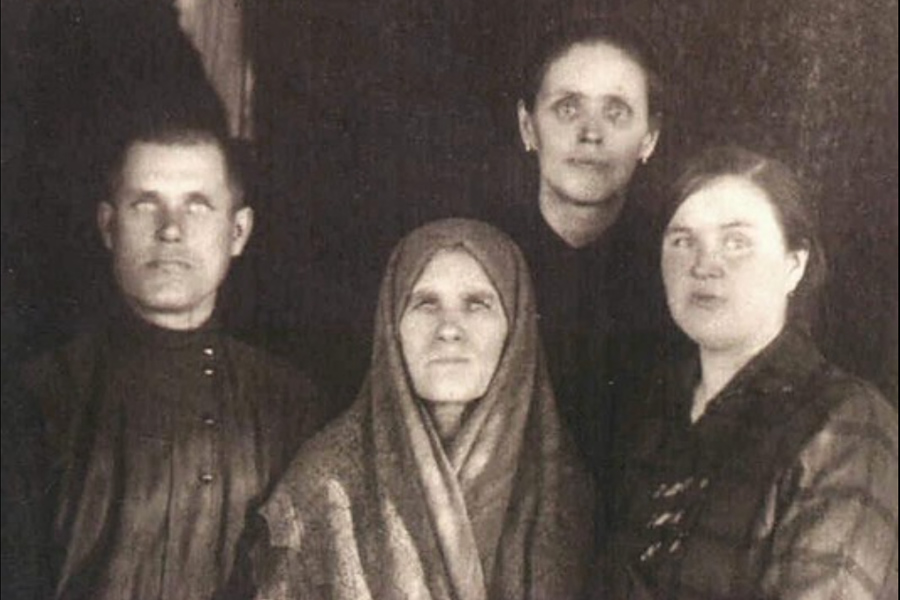
Praskovia appears in Rasputin and family photos. She is photographed with her spouse in 1900, and later photos show the family in the 1920s and 1930s.
Photographs offer something written history cannot. They reveal a woman beyond her husband’s fame.
She wrote no influential books. Political office was not hers. No independent wealth was made. Her perseverance made her historic.
I think her story is a calm counterweight to Rasputin. Praskovia represented the family life underlying the mystique of imperial extravagance and political intrigue.
Family Relationships at a Glance
| Family member | Relationship to Praskovia | Known details |
|---|---|---|
| Fyodor Dubrovin | Father | Siberian peasant; details remain scarce |
| Nikolai Raspopov | Brother | Mentioned in genealogical records |
| Katya Pechyorkins | Sister | Details limited |
| Dunia Pechyorkins | Sister | Details limited |
| Grigori Rasputin | Husband | Married Praskovia in the late 1880s |
| Dmitri Rasputin | Son | Remained in Siberia and died during the Soviet era |
| Maria Rasputin | Daughter | Emigrated and became a performer and memoirist |
| Varvara Rasputina | Daughter | Remained in Siberia; later fate uncertain |
| Tatyana Soloviev | Granddaughter | Descendant through Maria |
| Maria Solovieff | Granddaughter | Descendant through Maria |
Frequently Asked Questions
Who was Praskovia Dubrovina?
Praskovia Dubrovina was a Siberian peasant woman who became known historically as the wife of Grigori Rasputin. She was born around 1865 or 1866 and spent most of her life connected with Pokrovskoye.
When did Praskovia Dubrovina marry Rasputin?
Praskovia and Grigori Rasputin reportedly married in February 1887 after meeting in Abalak in 1886. Some historical accounts give somewhat different dates.
How many children did Praskovia and Rasputin have?
The couple are generally said to have had seven births, although several children died very young. Dmitri, Maria, and Varvara are the three children generally recognized as surviving into adulthood.
Who was Praskovia’s most famous child?
Her daughter Maria Rasputin became the most publicly visible child. She emigrated from Russia, worked as a dancer and circus performer, and published memoirs about her father.
What happened to Praskovia after Rasputin died?
After Rasputin’s assassination in December 1916, Praskovia remained in Siberia. The Revolution and subsequent Soviet policies brought confiscation of property, loss of civil rights, and eventually repression against members of the family.
Did Praskovia have her own career?
There is no well-documented independent professional career for Praskovia. Historical accounts primarily describe her as a peasant wife, homemaker, and mother who managed the family household while Rasputin traveled.
What happened to Praskovia during the Soviet period?
She was reportedly deprived of voting rights in 1922 with Dmitri and Varvara and later became caught in the Soviet system of arrests, labor camps, and special settlements. Her final years and exact death circumstances remain uncertain.
When did Praskovia Dubrovina die?
Her death is variously reported as occurring around 1930 or in June 1936. The later date is frequently repeated in genealogical and memorial accounts, but the evidence remains incomplete.
Was Praskovia involved in Rasputin’s political influence?
There is no strong evidence that Praskovia herself played a political role. Rasputin’s influence came from his personal relationship with Nicholas II and especially Alexandra Feodorovna. Praskovia remained largely in Siberia and outside the imperial court.
What is Praskovia Dubrovina remembered for?
She is remembered primarily as Rasputin’s wife and as the mother of his surviving children. Her own life was much quieter than her husband’s, but her family’s later suffering makes her an important figure in understanding the human consequences of the Russian Revolution and Soviet repression.
Available next action: Create a downloadable DOCX file here in this chat containing the editable prose above